Make an initial inquiry
Contact Yacht Provenance by email with your interest in the yacht and its history. No formal research proposal is needed. The preliminary consultation is a complimentary professional service, with no obligation to proceed.

The vessel is the subject. The evidence directs the investigation. The investigation determines the findings.
Yacht Provenance conducts comprehensive documentary research into the history and provenance of individual recreational vessels. An investigation may examine a vessel’s design, construction, ownership, alterations, voyages, and historical associations, following the evidence wherever it leads. The resulting dossier documents the research undertaken, evidence located, conclusions responsibly supported, and questions that remain unresolved. The availability, completeness, and historical significance of surviving evidence cannot be predicted or guaranteed.
Design and construction. Ownership and alterations. Voyages, records, and associations.
A yacht’s history rarely survives in one place. Plans, photographs, registration records, correspondence, and contemporary accounts may each preserve a different part of the record.
Yacht Provenance examines available evidence across these sources, tests apparent connections, and records what can—and cannot—be established. Conflicting accounts, gaps, and unsuccessful searches are part of the investigation, not details to be concealed.
One comprehensive investigation brings these connected questions together; it is not a collection of separate research services.
Consider an investigation ↗Thelma is a custom, one-off wooden sailing yacht whose history extends across successive ownerships, substantial alterations, major rebuilding, and voyages spanning several decades.
Her changing configuration reflects the purposes, technologies, and preferences of those who owned and sailed her. Reconstructing that history required examining surviving documents, comparing them with the vessel herself, following accounts from people associated with her, and pursuing leads that did not always produce answers.
One particular discrepancy illustrates how this investigation proceeded.
During the historical investigation, a modified design drawing was compared with measurements of Thelma’s installed rudder. The comparison revealed that the drawing did not accurately represent the rudder’s actual configuration.
The investigation provides a concrete illustration of Yacht Provenance’s three governing principles.
The investigation examined Thelma as she actually existed, comparing her physical configuration with her original design drawings and later modification records. Particular attention was given to the rudder, which had been substantially altered from its original design.
Measurements of Thelma’s installed rudder revealed that its leading edge was sharper and extended farther forward than the modified drawing indicated. This discrepancy prompted further examination of the available evidence rather than acceptance of the drawing as an accurate representation.
The comparison established that the modified drawing did not accurately represent the installed rudder. The discrepancy was documented without inventing an explanation for the difference or claiming to resolve questions the surviving evidence could not answer.
The rudder was only one aspect of Thelma’s history. Other investigations concerned her original construction, subsequent rebuilding, changes in accommodation and equipment, and the people and circumstances associated with her life.
Some questions could be addressed through surviving documents and physical evidence. Others remained unresolved despite further inquiry.
The resulting abridged historical account follows selected episodes in Thelma’s life. It is presented with the client’s permission, with identifying information withheld to protect privacy.
This private investigation preceded Yacht Provenance’s current AI-enhanced research architecture; it is not presented as a completed Yacht Provenance client commission.
Explore Thelma’s History ↗An inquiry begins with the vessel and what is already known. Yacht Provenance then considers whether a comprehensive documentary investigation is suitable, what research may be feasible, and which questions deserve priority. Not every inquiry leads to a commission.
Commission an investigation ↗For inquiries, email inquiries@yachtprovenance.com.
Herreshoff, Nathanael G. Vigilant, Herreshoff Manufacturing Company Build No. 437. Original hand-carved half-hull design model, ca. February 1893. Scale 1:24; length 63½ inches. Model No. 702, Herreshoff Marine Museum, Bristol, Rhode Island. Photograph copyright by the Herreshoff Catalogue Raisonné, used by Yacht Provenance LLC with permission for free public access.
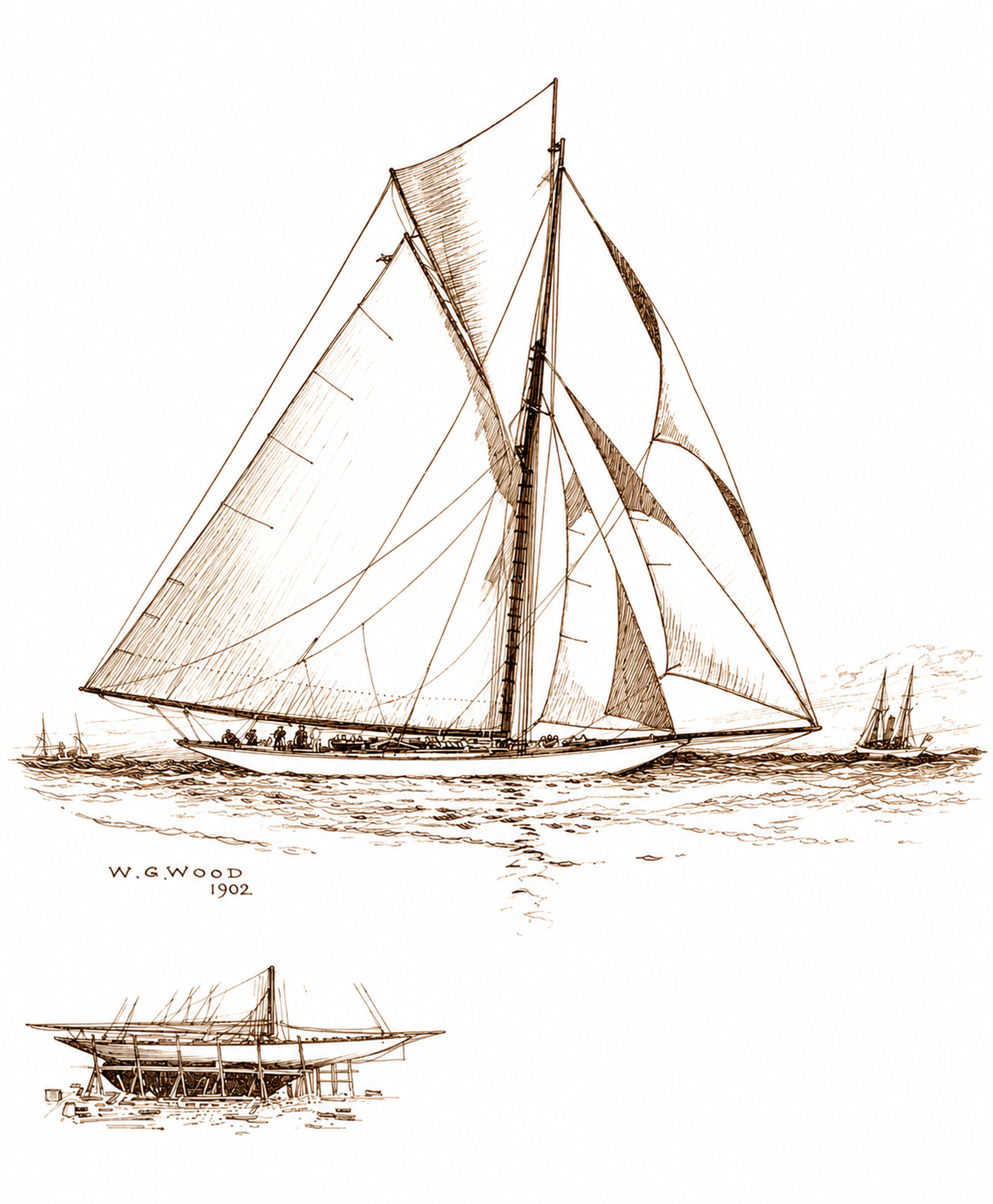
Wood, Worden G. “Vigilant: Defender of the America’s Cup, 1893, against Valkyrie II.” Pen drawing after photographs. Inset. In Thomas W. Lawson, The Lawson History of the America’s Cup, 139. Boston, 1902.
Peabody, Henry G. Vigilant, September 9, 1893. Photograph. Detroit Publishing Company Collection, Prints and Photographs Division, Library of Congress. Call no. LC-D4-5380; reproduction no. LC-DIG-det-4a04765. Library of Congress catalog record.
Wood, Wordon G. “Vigilant. Defender of the America’s Cup, 1893, against Valkyrie II”. From a pen drawing by W. G. Wood, after photographs. Image Date: 1902. Published in: Lawson, Thomas. The Lawson History of the America’s Cup. Boston, 1902, p. 139. The Yacht Provenance Logo.
Unidentified photographer. Vigilant with Yawl Rig. Photograph, 1901 or later. Reproduced in L. Francis Herreshoff, The Wizard of Bristol: The Life and Achievements of Nathanael Greene Herreshoff, Together with an Account of Some of the Yachts He Designed (New York, 1953), 128–129.
OpenAI. Vigilant as She Is Remembered Today. AI-generated illustration created using ChatGPT, October 15, 2026. Produced for Yacht Provenance LLC.
The enterprise, its research method, suitability assessment, and professional responsibilities.
Yacht Provenance is an independent research enterprise providing one comprehensive service: the documentary investigation of the history and provenance of an individual recreational yacht.
The enterprise is directed by its Principal, who retains responsibility for the conduct of the research, evaluation of evidence, and findings presented to clients.
Historical investigation is supported by a purpose-built, AI-assisted research system that helps locate, organize, sort, compare, examine, and retrieve information concerning the yacht under investigation. At its core is a proprietary relational database architecture developed specifically for Yacht Provenance and subjected to extensive testing.
By supporting the time-intensive work of information discovery and management, this architecture allows the Principal to devote greater attention to evaluating evidence, pursuing promising leads, contacting individuals and institutions, examining original documents, and making the investigative judgments that require human experience and critical reasoning.
The system supports, but does not replace, the Principal’s professional judgment. It does not establish historical facts by assertion.
Yacht Provenance offers one comprehensive documentary investigation of an individual recreational yacht. It examines the yacht’s origins, design, construction, builders, ownership, names, alterations, voyages, and historical associations where the surviving evidence supports such inquiry.
The vessel as a whole remains the subject of the investigation. Clients are encouraged to identify questions, uncertainties, or historical claims of particular interest; these guide research priorities but neither restrict its scope nor predetermine its conclusions. Evidence that contradicts a client’s expectations receives the same critical consideration as supporting evidence.
Yacht Provenance provides independent documentary research into yacht history and provenance.
To maintain our independence from commercial yacht sales and assessments, Yacht Provenance does not provide yacht asking prices, sale prices, comparable-sales information or valuations. Our investigations focus on documenting each vessel’s history and evaluating the evidence on its own merits. When relevant and supported by a source, a report may include the yacht’s historical construction cost. This policy applies to reports, supporting documents, Client Portal content, consultations, and correspondence. Yacht Provenance does not provide appraisals, pricing advice, marketability assessments, or brokerage services.
A comprehensive investigation may connect records that appear unrelated when considered individually. For example, original plans and later photographs may establish that a yacht changed, while correspondence or yard records may help explain when and why.
For an authorized commission or collaboration, the Client Portal is intended to provide authenticated, client-specific access to the signed agreement, research status, significant developments, communications, and relevant expense information. Portal functions will be offered only after their security and operation have been verified.
Clients will be encouraged to ask questions, provide additional information, share documents or photographs, and identify people or sources who may have knowledge of the yacht. Even seemingly minor recollections can suggest worthwhile lines of inquiry.
The objective is to maintain meaningful communication throughout the investigation and enable clients to contribute their knowledge without assuming responsibility for directing or conducting the research.
Under a standard Client Commission Agreement, Yacht Provenance delivers three documents: an Executive Summary, a Documentary Dossier, and an accompanying Cover Letter. The Principal approves the exact final digital package for release. YP delivers it by email and provides access through the Client Portal. The professionally printed and bound set is produced from the applicable approved versions and mailed after the full examination period has elapsed and timely material objections affecting production have been addressed.
The dossier records supported findings, interpretations, conflicting evidence, unresolved questions, and material research limitations. A complete investigation does not guarantee a complete historical record or a particular discovery. The deliverables and supporting documents supplied to clients exclude yacht asking prices, sale prices, comparable-sales information and valuations. A report may include the yacht’s historical construction cost when relevant and supported by a source.
For a standard commission, the full 30-calendar-day examination period begins when complete electronic delivery of all three documents by email and notification have both occurred, at the later time if they occur separately. Earlier acknowledgment or acceptance does not shorten the period. During Days 31–60, a separate, limited process applies to specific, substantiated material-deficiency allegations or significant new evidence, as provided in the signed agreement.
Complimentary research collaborations are governed by a separate agreement for one comprehensive documentary investigation of an individual recreational yacht. The collaborating party’s questions guide priorities without narrowing that scope. If completed, the Principal-approved signed Cover Letter, Executive Summary and Documentary Dossier are delivered by email with access through the Client Portal. The full 30-calendar-day examination period starts after complete email delivery and notification, at the later time if separate. Earlier acceptance does not shorten it, and timely material objections remain subject to disposition. During days 31–60, the collaborating party may raise substantiated material research deficiencies or important new evidence, as provided in the agreement. Printed or mailed copies require a separate written agreement.
Yacht Provenance undertakes comprehensive documentary investigations of individual recreational yachts 40 feet LOA or greater. Historically significant vessels under 40 feet may also be considered on a case-by-case basis. However, Yacht Provenance has found that not every vessel, or every research request, is necessarily suited to this form of investigation.
Before proposing a commission, Yacht Provenance, working with a prospective client, considers the vessel’s known history, the availability and accessibility of potential sources, the client’s interests, and whether a comprehensive documentary investigation is an appropriate service. This preliminary assessment cannot predict the importance or quantity of information that may be discovered.
Some yachts have complex construction or ownership histories, significant alterations, or surviving records that merit detailed examination. Others may have relatively straightforward histories, limited documentation, or research needs better served by a narrower specialist service. Beyond the initial length guideline, suitability is not determined simply by a yacht’s age, size, value, or reputation.
If Yacht Provenance concludes that its comprehensive service is not appropriate, it will discuss its assessment with the client and, where possible, recommend a different provider or type of service better suited to the yacht and the client’s needs. Clients seeking pricing, valuation, marketability assessment, or brokerage services may be referred to independent providers.
An inquiry does not obligate the client to commission research or Yacht Provenance to accept it.
The research process begins by establishing the vessel’s unique identity and assembling available information from the prospective client, including documents, recollections, and suggested sources. This information is examined in context, compared, and evaluated for reliability and relevance.
Positive identification of the vessel, established with sufficient documentary confidence, is a prerequisite to commencing the comprehensive historical investigation.
Most Yacht Provenance research is directed from the company site. Depending on the vessel and available leads, methods may include deep internet research, online archives, interlibrary loan and document-delivery inquiries, remote museum and private-collection access, designer and boatyard archive inquiries, government records requests, historical newspapers and periodicals, interviews and oral histories, and correspondence with knowledgeable individuals and institutions. We know, however, that some records cannot be accessed remotely, and may have been lost to time.
Research is not limited to answering questions already formulated. An inquiry may reveal previously unknown individuals, events, documentary connections, or questions worth pursuing. It may also establish that records are unavailable or that a lead cannot be substantiated.
The client remains an important participant throughout the investigation. Additional recollections, documents, contacts, or sources may emerge as the work progresses. New information is examined and incorporated into the research record as appropriate, and may suggest further lines of inquiry.
AI-assisted tools support searching, sorting, organizing, comparing, retrieving, and reviewing potentially relevant information. They do not guarantee discoveries or establish historical facts. The Principal directs the inquiry, determines which leads warrant examination, and retains responsibility for evaluating evidence and reaching conclusions.
When a promising lead requires examination at a particular location, Yacht Provenance may propose engaging a qualified local researcher or archivist, or having the Principal travel to conduct the research.
Yacht Provenance will discuss the purpose of the proposed work, its potential research value, anticipated activities, and reasonably estimable requirements with the client. No off-site research will be undertaken without a separate client decision and authorization.
The work undertaken, sources examined, information obtained, and any resulting findings or limitations will be documented and reported to the client.
At the center of Yacht Provenance’s research system is a proprietary, custom-developed relational database architecture designed specifically to support the investigation of yacht history and provenance.
The architecture uses PostgreSQL, an object-relational database management system designed to store, organize, and manage structured information while providing mechanisms to ensure data integrity and support security, reliability, and high performance. Its design supports evidence traceability, preservation of conflicting information, systematic review, and the continuing examination of an expanding documentary record. The architecture has been developed and examined through staged design, testing and verification studies.
Its purpose is not to establish historical truth automatically, but to provide a disciplined information environment in which evidence can be retained, compared, challenged, and reconsidered.
Research activities are organized around four complementary functions:
Discovery: Seeking documentary evidence, individuals, collections, historical connections, and previously unrecognized leads.
Acquisition: Requesting and obtaining accessible records, reproductions, documents, and testimony through digital resources, correspondence, institutions, and authorized outside researchers.
Investigation: Comparing evidence, testing historical claims, reconstructing events where the evidence permits, and identifying contradictions and unresolved questions.
Preservation: Maintaining the documentary record, its provenance, source references, and the reasoning supporting the investigation’s findings and limitations.
The completeness of the research effort is distinct from the completeness of the surviving historical record and the certainty of its conclusions. A carefully conducted investigation may remain inconclusive. Contradictory records are not silently reconciled, and the absence of documentation is not treated as proof that an event did not occur.
Throughout this process, the Principal retains responsibility for the investigation, its interpretations, and the dossier. Yacht Provenance does not provide marine surveying, appraisal, valuation, pricing advice, marketability assessment, brokerage services, engineering evaluation, or assessment of physical condition as part of its historical research service.
A standard commission ordinarily follows five client-facing stages. These describe the engagement, not a fixed timetable or a rigid sequence for historical inquiry.
A complimentary professional discussion considers the yacht, the prospective client's interests, and whether Yacht Provenance is an appropriate research service. An inquiry does not obligate either party to proceed.
A commission begins upon execution of the applicable written agreement and satisfaction of its commissioning requirements. Both standard commissions and complimentary collaborations cover one comprehensive documentary investigation, with questions given appropriate priority under the applicable agreement.
The client and Principal examine available historical information, photographs, documents, recollections, and possible sources. The client may continue contributing relevant information as the investigation progresses.
Yacht Provenance directs the inquiry, evaluates evidence, and pursues relevant leads with professional judgment. Progress and material developments may be communicated through the authorized Client Portal. Research findings are not predetermined and no fixed investigation duration is promised.
For the standard commission, the Principal-approved Executive Summary, Documentary Dossier, and signed Cover Letter are delivered by email and made accessible through the Client Portal. The professionally printed and bound set is produced and mailed after the full examination period and disposition of timely material objections affecting production. If a material error made by YP requires the printed and bound dossier to be reprinted, YP pays the reasonable costs of reprinting and delivering the corrected set. The signed agreement governs examination, objections, corrections, and closure. A completed complimentary collaboration also provides three digital documents by email with portal access and the examination and follow-up provisions in its separate agreement. Printing or mailing requires a separate written agreement.
Yacht Provenance respects the privacy of its clients and collaborating researchers. Their identities, communications, and nonpublic information are treated as confidential, subject to disclosures reasonably necessary for authorized research or required by law.
Historical investigation may require identifying a yacht when consulting archives, museums, designers, historians, and other relevant sources. Such inquiries are part of the research process and do not constitute public announcement or promotion of a commission. YP does not ordinarily disclose the identity of the commissioning party when it is unnecessary to the investigation.
For standard paid commissions, YP does not publicly announce, publish, or distribute the commissioned research or dossier without the client's express written authorization.
As the standard condition for waiver of the professional research fee, complimentary collaborations include express authorization to publish completed research, subject to third-party rights, source restrictions and any exception agreed in writing by the Principal and collaborating party. YP will not publish the completed dossier until the full 30-calendar-day examination period has elapsed and timely material objections affecting publication have been addressed. Publishing unfinished research following discontinuation requires separate written authorization. The collaborating party’s personal identity remains confidential unless disclosure is separately authorized.
Access to private commission documents and communications is restricted to the appropriate client or collaborating researcher and authorized YP personnel through the secure Client Portal.
The specific rights and obligations governing each investigation are established in its signed commissioning agreement.
Patrick Fitzhorn, PhD - Principal, Yacht Provenance
Patrick Fitzhorn came to Yacht Provenance through a lifetime of interests that had not originally been intended to converge. His involvement with yachts began as a young man, when sailing led him to study yacht design at the Westlawn School of Yacht Design and subsequently to work in hull design at Newport News Shipbuilding. He later earned degrees in computer science and mechanical engineering and spent 35 years on the faculty of Colorado State University, where his work encompassed computation, engineering research and teaching. Alongside that professional career ran enduring interests in yachting, historical instruments and the recovery of technical history. Ownership of the yacht Marionette turned those interests toward the documentary reconstruction of an individual vessel: comparing plans with the yacht as she actually existed, identifying modifications, interviewing a previous owner and trying to recover how and why the vessel had changed. After retirement, Fitzhorn began assembling increasingly detailed research dossiers on yachts that interested him. Eventually the investigations became rewarding independently of whether a vessel might actually be purchased. Research into a Stephen Seaton trawler exposed a discrepancy in her documented history and became the immediate precursor to Yacht Provenance. Yacht Provenance brought together pursuits that had previously remained largely separate: vessels, engineering habits of inquiry, computation, historical research and collaborative investigation. Fitzhorn serves as Yacht Provenance's Principal and bears its human, legal and professional responsibility. His engineering background informs the discipline with which Yacht Provenance approaches evidence; it does not make Yacht Provenance an engineering, surveying, appraisal or physical-condition service. At the center of his role is a longstanding attraction to difficult questions—particularly those for which the answer is not yet known.
A Historic Yacht. A Documentary Heritage.
The Yacht Provenance brandmark depicts Vigilant, the celebrated American racing yacht designed by Nathanael Greene Herreshoff. It is the pencil drawing of Worden G. Wood, dated 1902, used in The Lawson History of the America's Cup: A Record of Fifty Years (1902), attributed to Thomas W. Lawson and Winfield M. Thompson.
Vigilant was constructed by the Herreshoff Manufacturing Company as construction No. 437, an innovative steel-and-Tobin-bronze centerboard racing cutter, approximately 128 feet in overall length, with a waterline length of 86 feet 3 inches. Launched on June 14, 1893, Vigilant became one of the most historically significant American racing yachts of her era.
Representing the New York Yacht Club, she successfully defended the America's Cup in October 1893, defeating the British challenger Valkyrie II in three consecutive races. This victory established Vigilant as Herreshoff's first victorious America's Cup defender and placed her prominently in the history of American yacht design and international yacht racing.
Historical source attribution requires independent page-level verification before publication.
Yacht Provenance undertakes one comprehensive documentary investigation of an individual recreational yacht. Each investigation examines the available historical record with scholarly independence. A client’s questions guide research priorities, but do not limit the scope or predetermine the findings.
Yacht Provenance provides independent documentary research into yacht history and provenance.
To maintain our independence from commercial yacht sales and assessments, Yacht Provenance does not provide yacht asking prices, sale prices, comparable-sales information or valuations. Our investigations focus on documenting each vessel’s history and evaluating the evidence on its own merits. When relevant and supported by a source, a report may include the yacht’s historical construction cost.
This policy applies to reports, supporting documents, Client Portal content, consultations, and correspondence. Yacht Provenance does not provide appraisals, pricing advice, marketability assessments, or brokerage services.
Clients seeking pricing, valuation, marketability assessment, or brokerage services may be referred to independent providers.
Contact Yacht Provenance by email with your interest in the yacht and its history. No formal research proposal is needed. The preliminary consultation is a complimentary professional service, with no obligation to proceed.
Provide the yacht’s present and former names, if known, and whatever identifying information is available: designer, builder, year, dimensions, registration details, or other clues. Explain the questions that particularly interest you. Incomplete information is welcome.
The Principal considers whether the yacht, the prospective client’s goals, and Yacht Provenance’s comprehensive research service are a suitable match. If the proposed work is not appropriate, Yacht Provenance will explain why and, where possible, suggest another kind of assistance.
If both parties decide to proceed, Yacht Provenance provides the full Client Commission Agreement for review, including the professional fee, research expense reserve, deliverables, and client rights. The commission is authorized when the agreement has been signed and the initial payment received.
The Principal conducts a detailed consultation with you, ordinarily by telephone or video conference, to examine the yacht's known history, available documents, drawings, photographs, correspondence, and your recollections. This discussion helps establish the documentary foundation for the investigation and may reveal important research leads. Rare or irreplaceable originals should not be sent to Yacht Provenance without prior arrangements.
Yacht Provenance investigates the yacht’s origins, construction, design, ownership, use, alterations, and other relevant historical questions. Research may involve archives, museums, government records, historical publications, private collections, and knowledgeable individuals. Yacht Provenance evaluates conflicting accounts and distinguishes supported findings from interpretation and uncertainty.
Through the secure Client Portal you can follow research progress, provide additional information, ask questions, and review an itemized account of authorized third-party research expenses. The Principal may also share selected preliminary material for factual comment. Preliminary material supplied to clients is subject to the same policy excluding yacht asking prices, sale prices, comparable-sales information and valuations. Extraordinary research or travel expenses require your prior written authorization.
The investigation culminates in an Executive Summary, Documentary Dossier, and accompanying Cover Letter. The Principal approves the exact final digital package for release. All three documents are then delivered by email and made accessible through the Client Portal. After the full examination period has elapsed and timely material objections affecting production have been addressed, the professionally printed and bound set is produced from the applicable approved versions and mailed to you. The dossier documents evidence examined, conclusions supported, material limitations, and questions that remain unresolved. Significant discoveries or definitive answers cannot be guaranteed.
Your full 30-calendar-day examination period begins when complete electronic delivery of all three documents by email and notification have both occurred, at the later time if they occur separately. During that period you may examine the documents, ask questions, seek clarification and raise material objections. Earlier acknowledgment or acceptance does not shorten the period. An unresolved timely material objection is not treated as resolved solely because the period has expired. Closure follows completion of applicable delivery, examination, objection and financial-accounting requirements. During days 31–60, you may identify a substantiated material research deficiency or important new evidence; the Principal may elect a limited continuation as described in the agreement. If a material error made by YP requires the printed and bound dossier to be reprinted, YP pays the reasonable costs of reprinting and delivering the corrected set.
To maintain our independence from commercial yacht sales and assessments, Yacht Provenance does not provide yacht asking prices, sale prices, comparable-sales information or valuations. Our investigations focus on documenting each vessel’s history and evaluating the evidence on its own merits. When relevant and supported by a source, a report may include the yacht’s historical construction cost.
This policy applies to reports, supporting documents, Client Portal content, consultations, and correspondence. Yacht Provenance does not provide appraisals, pricing advice, marketability assessments, or brokerage services.
Prospective clients may examine the full standard agreement, including fees, research expenses, confidentiality, dossier rights, and provisions for cancellation and completion, before deciding whether to commission Yacht Provenance.
This reference copy is provided for advance review and is not an agreement for signature. The terms governing a commission are those in the agreement subsequently signed by both parties.
Contact Yacht Provenance by email: inquiries@yachtprovenance.com
A planned means for commissioned clients to receive research updates and access vessel-specific materials. Client account access will be available through the private Client Portal.
Authentication, case records, and document access have not been implemented. No real credentials should be entered.
Principal-reviewed research developments, significant findings, emerging questions, and changes in interpretation as the investigation proceeds.
Explore journal design ↓Executed agreement and authorized scope
Verified milestones and updates
Approved deliverables and shared evidence
Notices and next steps
A developing account of the investigation, prepared for the client as research progresses.
The journal will present selected research developments in understandable language, supported by source references where appropriate. The policy excluding yacht asking prices, sale prices, comparable-sales information and valuations applies to journal entries and all other Client Portal research content. Relevant, source-supported historical construction costs are permitted under that policy. It will help clients follow the inquiry, recognize important uncertainties, and contribute information before the Documentary Dossier is completed.
Important discoveries and the documentary evidence supporting them.
Conflicting accounts, unresolved historical questions, and matters requiring further investigation.
Provisional assessments, their evidentiary limitations, and material changes as new sources are examined.
Questions and requests for information that may help clarify the historical record.
Publication and evidentiary controls. Journal entries are intended to be prepared from the research engine's recorded evidence and released following Principal review. Entries will carry dates, source references or limitations as applicable, and a clear distinction between provisional and established findings. Material corrections will be recorded rather than silently replacing earlier reports. The journal is not the final Documentary Dossier.
Client-specific journal entries and documents will be available through the private Client Portal.